Category grouping with Pattern Match
Pattern matching provides a powerful way to analyse sequences of transactions but, in some cases, you may consider it too granular to conduct analysis at the individual transaction level - for example, examining a person's twice-weekly supermarket shop, or monthly charitable donation. In such cases it is possible to combine the power of Category Grouping and Pattern Match aggregation techniques to:
- First, group transactions by an ordinal selector variable;
- Next, apply a numeric function to all the transactions in each group;
- Then, define and search for a pattern of interest.
Note
You can carry out this analysis by creating an on the fly aggregation directly within the Expression editor. Alternatively - as described below - you can follow the steps of the Sequence Analysis wizard to generate the expression.
Scenario
Identify the longest sequence of years in which a person's total holiday spend strictly increases
To get started:
- Open the Sequence Analysis wizard.
-
Select the Bookings table as the transactions to analyse and People as the grouping table.
The grouping variable must be an ordinal selector type. In this example, the Booking Year virtual variable has been created from Booking Date.
-
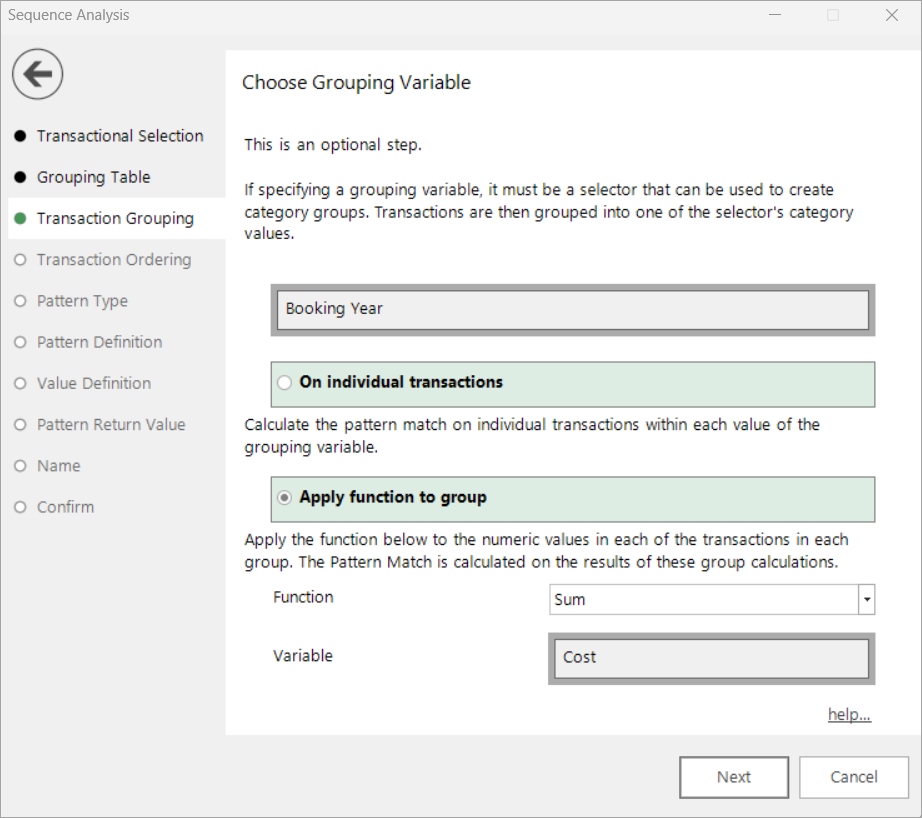
Drag and drop Booking Year as the grouping variable.
At the bottom of this step, you now have the option to work at the default individual transaction level, or to select a numeric variable and apply a numeric function to the transactions within each group.
-
Select Apply function to group.
-
Set Sum as the numeric function and drag and drop Cost as the function variable, then click Next.
You move directly to the Value Definition step to select the required pattern definition type.
-
Select Longest Strictly Increasing.
No include or exclude lists are necessary in this example, so you can proceed to define the return information.
-
Select to return the Pattern Length.
- Name the expression.
-
Review the settings and Finish.
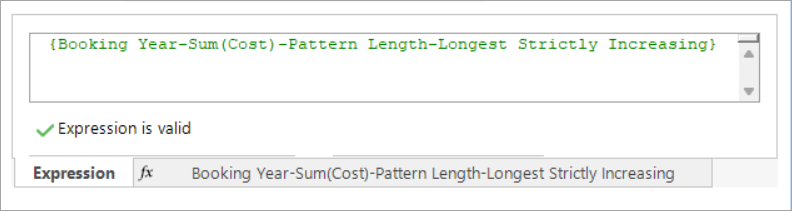
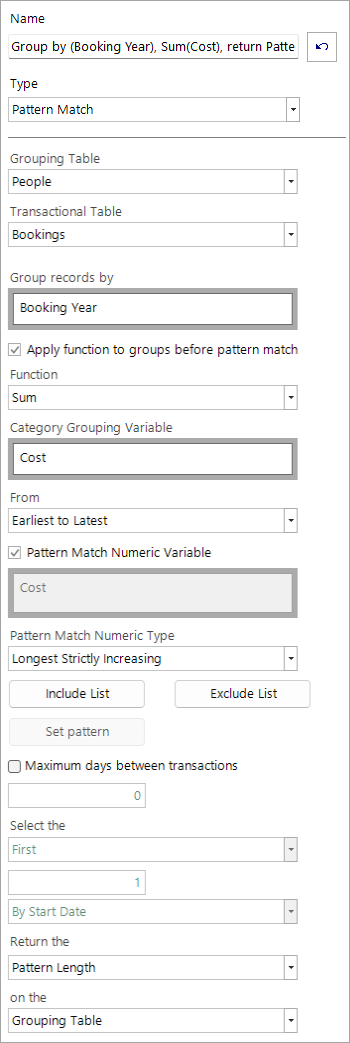
You can review and verify results using a data grid:
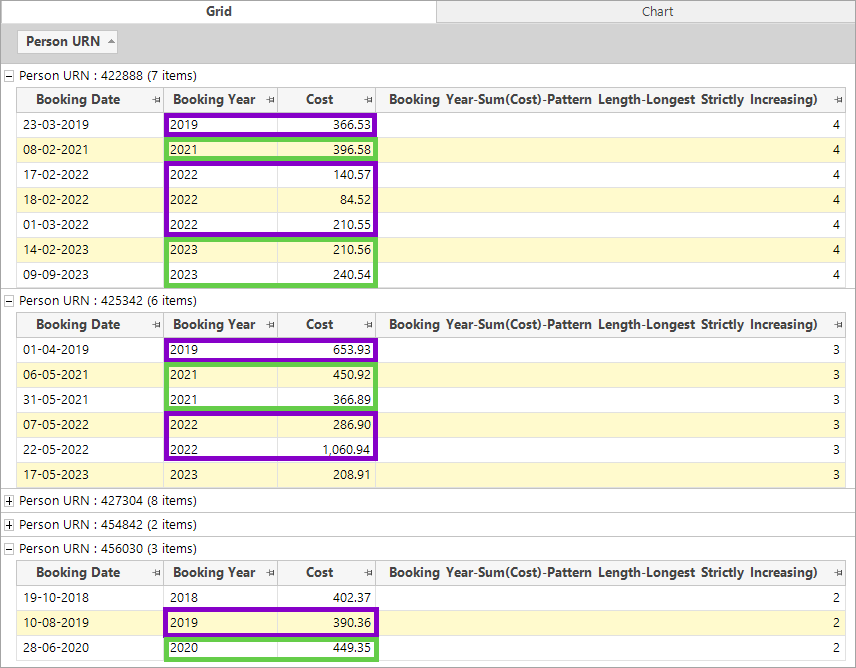
- Person URN 422888 has seven holiday bookings in four separate years and the sum of the cost of the bookings in each has increased, returning a longest sequence of 4.
- Person URN 425342 has six bookings in four separate years. Whilst the sum of the cost increased across three of those years, there was a drop-off in 2023. The longest sequence is 3.
- Person URN 456030 has three bookings of a similar value in three separate years, but only the second and third demonstrate the required increase in value and, therefore, a pattern length of 2 is returned.
Related topics: